

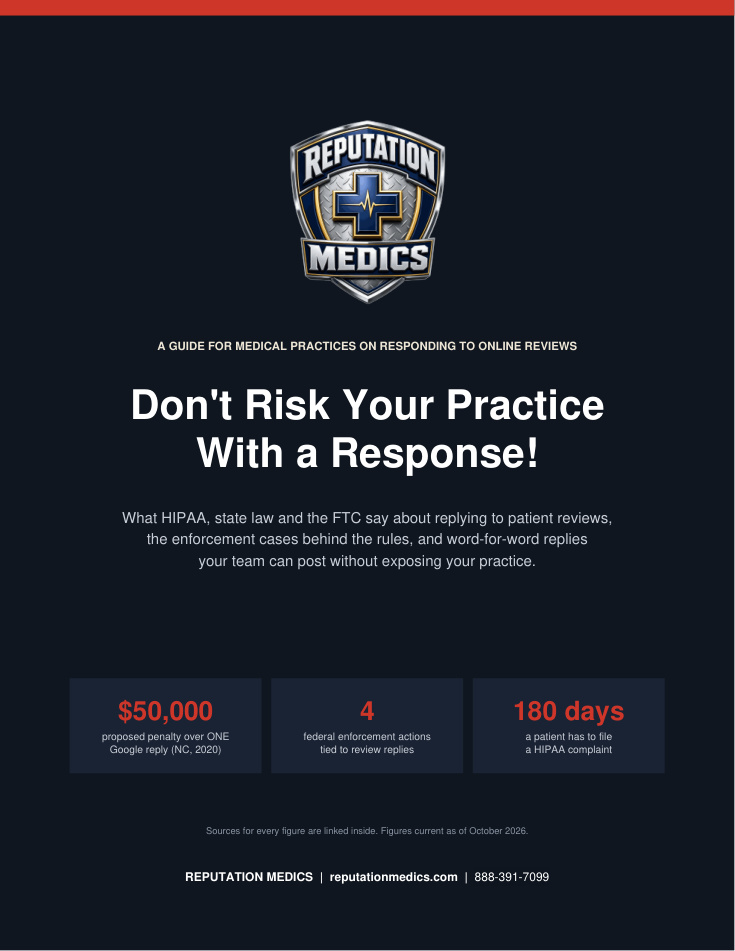
General education, not legal advice. Reputation Medics is not a law firm. HIPAA coverage, state confidentiality laws and additional rules vary. The supplied PDF retains its October 2026 legal text and earlier proposed-penalty example. This page distinguishes the final HHS outcome. Ask a qualified healthcare attorney to review your policy. No response template guarantees compliance.
What HIPAA allows when responding to patient reviews
The HIPAA Privacy Rule restricts a covered entity's use and disclosure of protected health information, or PHI. Health information includes care, health conditions and payment for care when it identifies an individual. A public review response is not automatically an authorized disclosure.
A patient's decision to write about their care does not authorize your practice to confirm the story or publish the rest of it. Your reply is a separate disclosure. The AMA's review-response guidance explains why physicians should avoid patient-specific replies and acknowledgement of the patient relationship.
Does HIPAA apply to every medical practice or med spa?
No. HHS explains healthcare providers are covered entities when they conduct specified electronic transactions. Do not assume every cash-pay clinic is exempt or every wellness business is covered. Check your actual operations with counsel. State confidentiality law and professional duties still matter where HIPAA does not apply. Read HHS's covered-entity guidance.
Patient details to keep out of a public review response
The privacy risk is often in a reply which sounds like ordinary customer service. Keep these details out of public responses, whether the review is positive, negative or disputed:
- Confirmation the reviewer is or was a patient, or their family member received care.
- Appointment dates, visit frequency, missed visits or discharge from the practice.
- Diagnoses, medications, symptoms, test results, procedures or treatment outcomes.
- Insurance status, unpaid balances, payment arrangements or refund discussions about an individual.
- Chart notes, clinical photos, consent forms or messages copied from private communications.
- Statements about a child's care or a family member's involvement.
Do not use patient records to win an online argument. A generic thank-you on a positive review should stay generic too. The relevant federal definitions and disclosure rules are in 45 CFR 160.103 and 45 CFR 164.502.
HHS enforcement cases involving online review replies
These are published enforcement outcomes, not hypothetical fines or a prediction of your liability. Settlements resolve potential violations. The dollar amounts below are case-specific, not today's annual HIPAA penalty limits.
2019 • Settlement and corrective action plan
Elite Dental Associates
$10,000
HHS investigated disclosures of patient information in responses on social media review sites.
2022 • Civil money penalty
U. Phillip Igbinadolor, D.M.D. & Associates
$50,000
HHS imposed a penalty following a Google review reply disclosing patient information. The supplied PDF cites the earlier 2020 proposed determination. HHS also publishes the final determination.
2022 • Settlement and corrective action plan
New Vision Dental
$23,000
The California dental practice resolved potential HIPAA violations involving disclosures in responses to online reviews.
2023 • Settlement and corrective action plan
Manasa Health Center
$30,000
The psychiatric practice resolved potential violations involving negative-review replies and privacy policies and procedures.
A review-response policy matters beyond the wording of one reply. Corrective action plans in these records include policies, training and oversight. If your practice has already disclosed information, involve your privacy officer or attorney in assessing breach-notification and other obligations. Deleting the reply does not settle those questions.
HIPAA-conscious review response examples for medical practices
People searching for HIPAA-compliant review responses usually need language their staff can use. These cautious examples avoid clinical details and patient confirmation. They are starting points for counsel-approved wording, not a compliance certification. Use your own practice contact information, never the patient's details.
General negative patient review
“Thank you for your feedback. We take concerns seriously. To protect privacy, we do not discuss individual matters online. Please contact our office directly and ask for the practice manager.”
Billing or insurance complaint
“We take feedback about communication seriously. We cannot discuss individual matters in a public forum. Please contact our office directly so the appropriate team member can address your concern privately.”
Suspected fake review
“We take all feedback seriously. Privacy rules prevent us from discussing any individual online. Please contact our office directly with your concern.”
Positive review
“Thank you for taking the time to share your feedback. Our team appreciates your kind words.”
Once a person contacts the office, verify identity and use an appropriate private channel. A public invitation to talk is not permission to send clinical details over an insecure message or to an unverified account.
Review-response risks across medical and dental specialties
Doctors, surgeons, dentists and orthodontists
Do not defend a procedure by describing a diagnosis, treatment recommendation or consent discussion. Dental X-rays, an implant plan, cosmetic-surgery history and a child's orthodontic visits are not public rebuttal material.
Mental health, addiction treatment and fertility clinics
Even confirming contact with a specialty clinic reveals sensitive context. Some substance-use-disorder records are subject to additional federal confidentiality rules. Have counsel assess the rules applicable to your services before adopting a generic review policy.
Med spas, medical aesthetics, therapy and senior care
Cash-pay services are not a reason to ignore confidentiality. Determine HIPAA coverage and applicable state rules. For senior communities, distinguish nonclinical services from healthcare operations rather than assuming the entire organization has one status.
Examples of state protections appear in New York's professional misconduct law, California's medical confidentiality law and Texas's medical records privacy law. This is not a complete state-by-state analysis.
Should a medical practice reply to a negative review or report it?
You do not have to reply. Escalate reviews involving legal threats, allegations of injury or possible privacy incidents before posting. A short neutral response is an option, not a requirement.
A reply will not remove a review. Google says reviews are eligible for removal when they violate its policies, not simply because the practice disagrees. Report suspected fake engagement, harassment, conflicts of interest or other applicable policy violations with relevant nonclinical evidence. Do not attach patient records to a platform report without an appropriate legal basis and privacy review.
Do not threaten a reviewer, buy fake praise or offer incentives conditioned on positive sentiment. The FTC's review rule prohibits specified deceptive practices and review suppression. Its Consumer Review Fairness Act guidance also addresses contract terms restricting honest reviews. A genuine policy-based removal request is different from trying to silence a legitimate complaint.
A medical practice review-response policy checklist
- Assign an owner. Limit who posts replies and who approves exceptions. Include agency and marketing staff.
- Approve neutral templates. Have the privacy officer or healthcare attorney review wording, channels and escalation rules.
- Separate public feedback from clinical records. Do not copy chart information into replies, agency tools or platform reports.
- Escalate sensitive complaints. Route legal threats, possible privacy incidents and clinical allegations to the right internal team before posting.
- Audit existing responses. Check Google, Yelp, Healthgrades, RealSelf, Vitals, Zocdoc and any other active practice profiles. Include positive-review replies.
- Document corrective action. Preserve an appropriate internal record and consult your privacy officer about deleting or editing disclosures and any further obligations.
- Train everyone with access. Include response-policy training at onboarding and revisit it when rules, vendors or staff change.
The final check: does the reply confirm this person's care, health or payments, or add information from your records? If so, stop and seek privacy review before posting.
Common questions about HIPAA and patient review responses
Can doctors respond to Google reviews without violating HIPAA?
HIPAA does not impose a blanket ban on replies. For a covered practice, the reply must not disclose protected health information without a permitted basis or valid authorization. Keep it general, avoid confirming the patient relationship and ask your privacy officer or healthcare attorney to approve the wording.
Does a patient review waive HIPAA privacy rights?
No. A patient's public disclosure is not the same as a valid HIPAA authorization for the practice to disclose information. Do not repeat, confirm or expand on the reviewer's treatment, visit or payment details.
Is saying someone is a patient a privacy risk?
Yes. Confirming a relationship with a healthcare provider links an identifiable person to care. AMA guidance advises physicians not to acknowledge the reviewer is a patient. Avoid phrases confirming a visit, procedure or ongoing treatment.
How should dentists respond to negative reviews?
Use the same privacy-first approach as other covered healthcare providers. Do not discuss X-rays, dental conditions, treatment plans, missed appointments or billing disputes. A neutral acknowledgement and an invitation to contact the office keep the public reply separate from private care.
What if a medical review is fake or the reviewer was never a patient?
Avoid a public chart-search rebuttal. Preserve nonclinical evidence privately and use the platform's reporting process if the review violates its policies. A negative rating or inability to identify a reviewer alone does not prove the review is fake.
Are these templates guaranteed HIPAA compliant?
No template guarantees compliance. These are general educational examples, not legal advice or a determination about your practice. Have a qualified healthcare attorney or privacy officer review your policy, including state rules and any additional confidentiality obligations.
See the full medical review FAQ for doctors, dentists and clinics
Official sources and further reading
This page draws on the supplied Reputation Medics guide and the official records below. The PDF's historical case figures are not a current penalty calculator. Always check the governing rules with qualified counsel.
- HIPAA Privacy Rule: uses and disclosures, 45 CFR 164.502
- HIPAA definitions: protected health information, 45 CFR 160.103
- HHS: covered entities and business associates
- AMA: are physicians prohibited from responding to online patient reviews?
- FTC: Consumer Reviews and Testimonials Rule questions and answers
- FTC: Consumer Review Fairness Act guidance
- Google: report inappropriate reviews
- Google Maps: prohibited and restricted content
- New York: professional misconduct, Education Law §6530
- California: confidentiality of medical information, Civil Code §56.10
- Texas: Medical Records Privacy, Health and Safety Code Chapter 181
- HHS: confidentiality of substance use disorder patient records